
Contactless technology has transformed the way we travel, shop and pay. Bank cards, travel cards, access cards and other RFID/NFC-enabled credentials are now part of everyday life.
That convenience is valuable. But it also means many of us carry several contactless credentials at the same time, often without thinking about when they are capable of interacting with a reader.
RFID shielding is not about suggesting that contactless technology is inherently unsafe. It is about giving people greater control over when their cards can communicate.
At Blocktek, we believe the strongest case for shielding is simple:
Keep your contactless credentials shielded while they are stored. Deliberately expose the card you want to use when you need it.
Fraud and Identity Crime Remain Significant
The wider fraud environment provides an important backdrop.
Recent figures cited in Blocktek’s RFID Shielding Briefing include:
- 4.5 million fraud incidents estimated by the Crime Survey for England and Wales in the year ending March 2026.
- Around 3.8 million fraud victims during the same period.
- £1.28 billion stolen through payment fraud in 2025, according to UK Finance.
- £46.8 million in reported contactless fraud losses during 2025.
- More than 242,000 identity-fraud cases recorded by Cifas.
- Only 12% of fraud and computer-misuse incidents captured by the Crime Survey were formally reported in the year ending March 2024.
Those figures do not mean every fraud starts with an RFID or NFC interaction. They do show why simple, low-burden preventative habits can be worthwhile.
What Is eSkimming?
Blocktek uses the term eSkimming to describe unauthorised reading or attempted interaction with a compatible contactless chip when the legitimate cardholder has not intentionally presented it.
Correctly used RFID shielding creates a physical barrier between the stored credential and compatible contactless reading technology.
The purpose is straightforward: while the card is shielded, it should not be available for normal contactless interaction.
When the cardholder wants to use it, they deliberately remove or expose it.
Accidental Payment Is Different From Card Clash
These two terms are often confused.
Accidental Payment
Accidental Payment occurs when a reader completes a payment from a contactless card that the owner did not intend to use.
For example, one person may deliberately present the correct card to make a payment, yet another compatible unshielded contactless card close enough to the reader may respond first or be selected.
In a nearby-person scenario, the unintended card may even belong to somebody else standing close to the payment point.
The unintended cardholder may know nothing about it until checking a later statement.
Card Clash
Card Clash is different.
It occurs when two or more compatible contactless credentials respond together and the reader cannot reliably determine which one should complete the transaction.
Instead of charging the wrong card, the transaction may simply fail or a transport gate may not open.
The practical lesson is the same: deliberate card selection matters.
How Contactless Readers Interact With Cards
Blocktek’s research, including work associated with the University of Bolton, examined how contactless readers and cards communicate.
The briefing describes the card initiating contactless communication, after which the reader enters a scanning period of approximately 1.2 seconds looking for responding compatible chips.
The research described interaction across static, mobile and handheld reader environments and highlighted why more than one contactless credential may potentially be involved in a transaction environment.
The briefing also references independent research demonstrating relay and protocol attacks under controlled conditions.
The point is not to suggest that every everyday transaction presents a serious threat.
It is to recognise a basic principle:
A contactless card that is physically shielded while stored cannot participate in normal contactless communication until it is deliberately exposed.
Why Under-Reporting Matters
Not every unusual transaction is formally recorded as a fraud incident.
A person may:
- Not notice a small unfamiliar payment until much later.
- Assume they simply forgot making the purchase.
- Receive a refund from their bank without making a formal report.
- Decide the value is too low to justify the effort.
- Be unsure whether what happened actually constitutes fraud.
This means the absence of a specific national category for every type of unwanted contactless interaction should not automatically be interpreted as evidence that such interactions cannot occur.
RFID Shielding Is an Additional Layer — Not a Complete Fraud Solution
It is important to be precise.
An RFID shield cannot stop phishing.
It cannot prevent account takeover.
It cannot stop somebody physically stealing a card.
And it cannot prevent every form of payment fraud.
That is not what it is designed to do.
Its role is narrower and more practical:
- Help prevent stored compatible cards from interacting with nearby readers.
- Encourage deliberate card selection.
- Reduce exposure to unwanted contactless interaction.
- Support safer everyday card-carrying habits.
It is one physical layer within a wider approach to personal financial and identity security.
Why NOMO Flippa Is Different
One increasingly common habit is carrying a backup bank card in the back of a smartphone case.
At first glance, that seems convenient.
But there is an obvious weakness: if the smartphone is lost or stolen, the backup card disappears with it.
The card may also remain unshielded while being carried behind the phone.
That is why Blocktek positions NOMO Flippa as a smartphone buddy — not a phone-case accessory.
The idea is simple: carry your backup bank card separately.
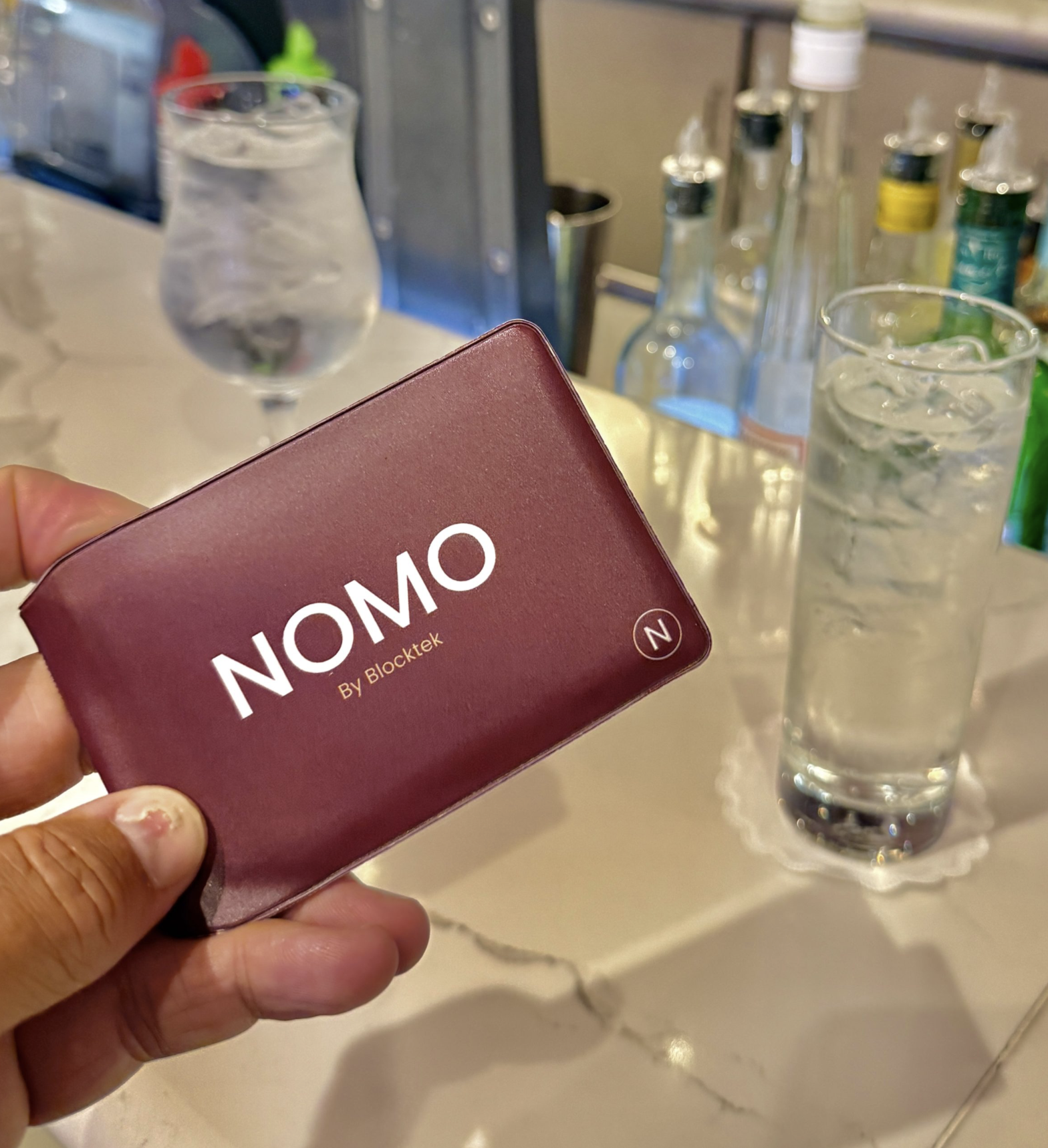
NOMO Flippa is a slim, two-card RFID shielding wallet designed to fit easily into a pocket, bag or purse.
It preserves the whole purpose of having a backup card in the first place: if your phone disappears, the backup remains somewhere else.
Flip. Tap. Pay. Close.
NOMO Flippa also provides a simple way to control the card you want to use.
The approved Flippa mechanism works like this:
- CLOSED: The shielding in the front cover protects both cards.
- FLIP OPEN: The card stored in the shielded front remains protected, while the chosen bank card in the intentionally unshielded rear becomes available to the contactless reader.
- TAP & PAY: Present the back of the open Flippa to the Point of Sale reader without removing your chosen bank card.
- CLOSE: Once payment is complete, close Flippa and both cards are shielded again.
Flip. Tap. Pay. Close.
It is about combining shielding with everyday convenience rather than adding unnecessary complexity.
But Banks Refund Fraud — So Why Bother?
Refund rights are important.
But even where money is eventually returned, an unfamiliar transaction can still create inconvenience and stress.
It may mean:
- Contacting the bank.
- Freezing or replacing cards.
- Reviewing other accounts.
- Gathering evidence.
- Completing fraud declarations.
- Checking credit files.
- Escalating complaints.
- Monitoring for further misuse.
Home Office research cited in the Blocktek briefing also records anxiety, distress, isolation, shame and embarrassment among fraud victims.
Prevention does not need to eliminate every possible risk to have value.
A simple measure can still be proportionate if it is inexpensive, easy to use and helps reduce a defined set of problems.
A Practical Everyday Habit
The most useful way to think about RFID shielding is not as a response to fear.
Think of it as control.
Keep cards shielded while they are stored.
Expose the card you intend to use.
Check your statements regularly.
Act quickly if you find an unfamiliar transaction.
And if you rely heavily on your smartphone for payments, keep your physical backup bank card somewhere separate from that phone.
That is the everyday case for Blocktek protection.
Carry Less. Just the Essentials.
Blocktek’s NOMO range is designed around a simple idea: practical protection without unnecessary bulk.
Whether using a single-card shield or a two-card NOMO Flippa, the principle remains the same:
Control when your contactless credentials are available. Carry your backup separately. Keep everyday protection simple.
Explore the Blocktek NOMO range and discover practical RFID shielding products designed for modern contactless life.
